Closed Loop
Features
Everything Closed Loop does today, in the private beta.
Planning
- A full plan to race day. Every week from today to the start line, not a rolling few weeks.
- Races from 5K to ultra. 5K, 10K, half marathon, marathon, or an ultra with your own distance.
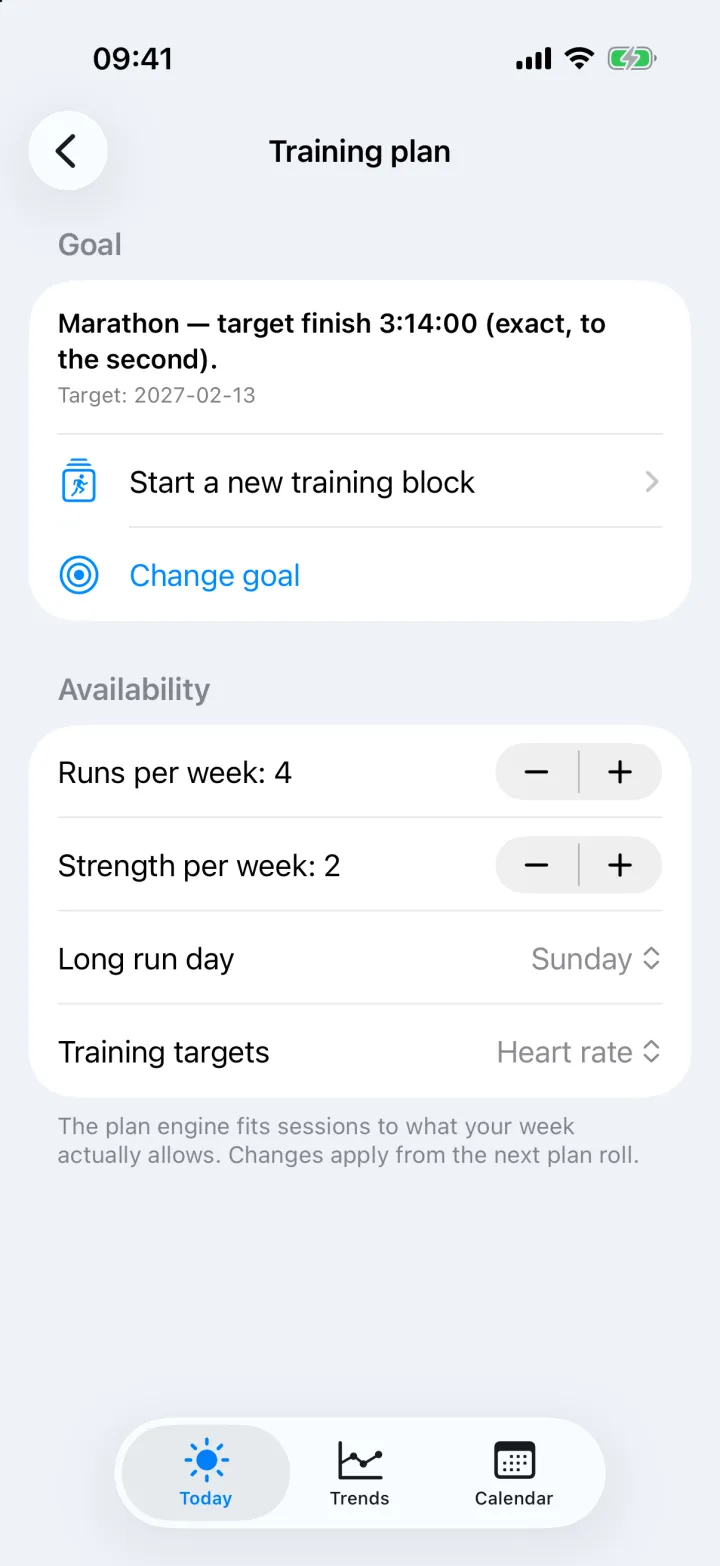
- A target time to the second. Or plan by level, with no time goal.
- Three levels. Beginner, intermediate and advanced plan structures for each race distance.
- Built around your week. You choose how many runs and strength sessions per week and which day holds the long run.
- Phases you can see. Base, build, peak and taper, each with a weekly distance target.
- Strength included, or not. Strength sessions are placed on non-running days where possible. You can switch them off.
- A reason for every session. Each one says why it is there.
- Heart-rate or pace targets. Choose which one your sessions are written in.
A plan that adjusts itself
- Weekly re-check. Each week the plan is compared with what you actually ran, and next week is adjusted.
- Walking and dancing count. Big step-count days are credited as aerobic work, so a week on your feet is not treated as a week off.
- Two kinds of load. Heart-and-lungs work and leg-impact work are tracked separately, so returning from a low-running week is neither too timid nor too fast.
- Ramp protection. If running load climbs too quickly, next week is eased.
- Honest goal check. Your fitness is estimated from your own runs and compared with your target time. You are told when the goal is on track, a stretch, or out of reach.
Daily coaching
- Morning verdict. Do today's session as planned, change it, or rest — and why.
- Evening look-ahead. What is coming tomorrow and how to prepare.
- Plain language. No jargon, and always tied to this week and your goal.
- Readiness. A go, modify or rest call from your recovery, sleep and recent load.
- How do you feel? One tap — strong, OK or rough — and the coach takes it into account.
- The best hour to run. From the forecast and your free time.
- One suggestion at a time. The coach may propose a change to a session or to the plan. You approve or dismiss it. Suggestions that are no longer relevant disappear on their own.
Run analysis
- What it was really worth. Pace corrected for climbing and for heat, shown beside the pace on paper.
- Heat measured properly. Uses humidity, sun and wind as well as temperature, because 29° in the shade and 29° in full sun are different runs.
- Plan versus reality. Whether the corrected run was on plan, ahead of it, or below it.
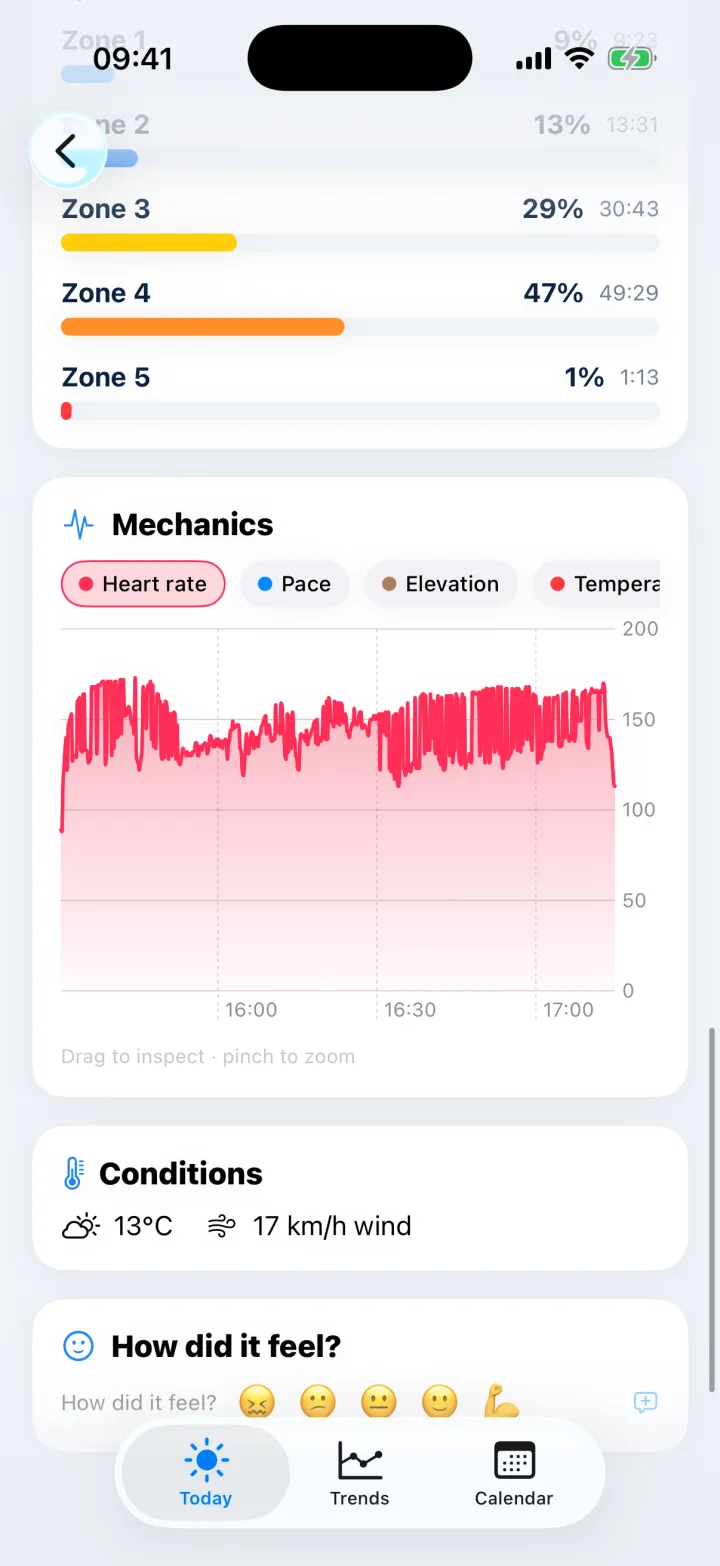
- Heart-rate read. Whether the effort matched what the session should have cost.
- Coach review. One thing done well and one thing to improve, after every run.
- Route map, heart-rate zones and running mechanics. Cadence, stride and elevation through the run.
- Treadmill aware. Indoor runs are recognised and shown without a map or weather.
- Planned and performed, side by side. See what was asked next to what you did.
Calendar
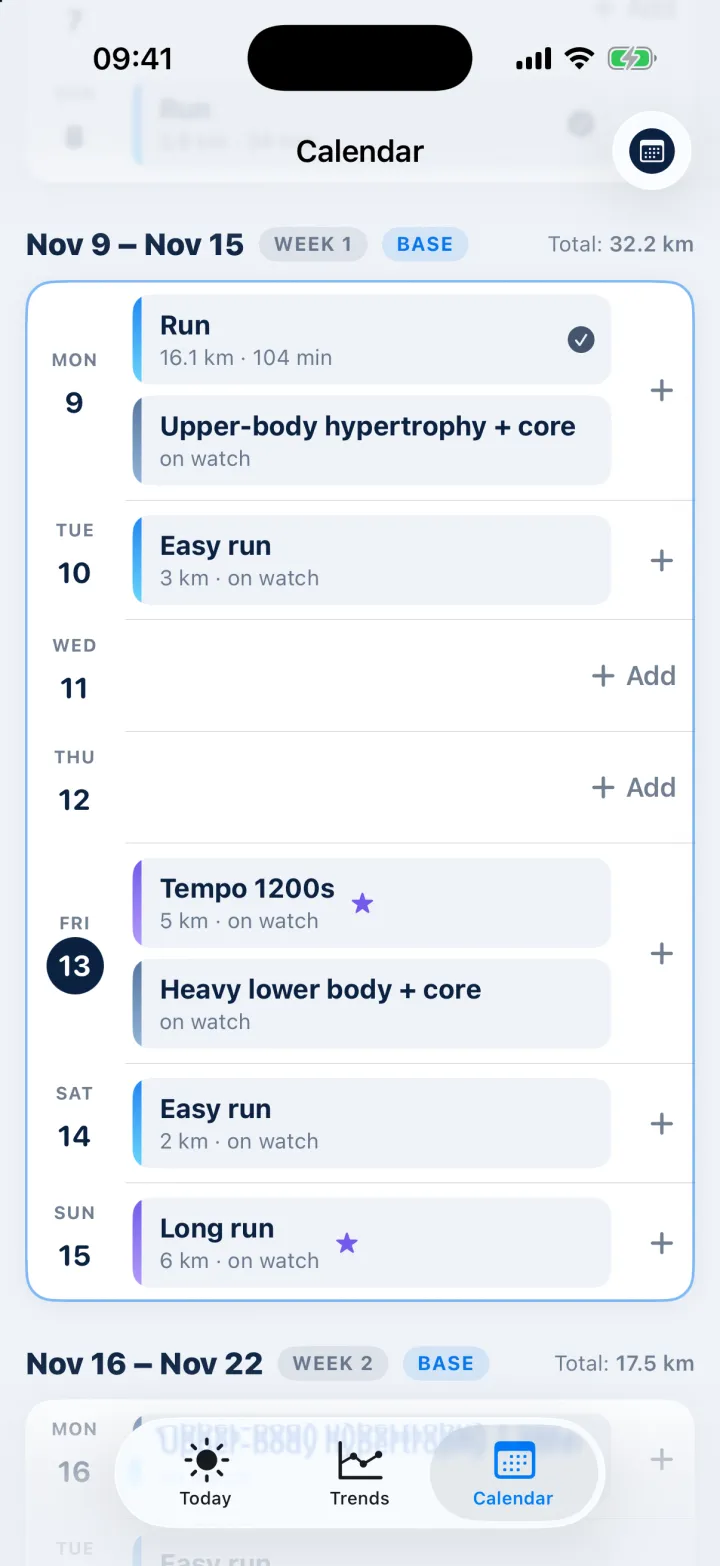
- Your whole plan as an agenda. Week by week, with the phase and the distance done against the target.
- Drag and drop. Move a session to another day and the plan and your watch follow.
- Add your own sessions. Start from a template and edit the steps.
- Edit by asking. Type “make it shorter” or “swap the intervals for a tempo” and the coach rewrites the session.
- Edit by hand. Change the duration, the zone, the steps or the repeats yourself.
- Swipe through days and weeks. The home screen always opens on today.
Trends
- Mileage. Planned against done, week by week, by type of run.
- Pace. How your running pace is moving over the last weeks.
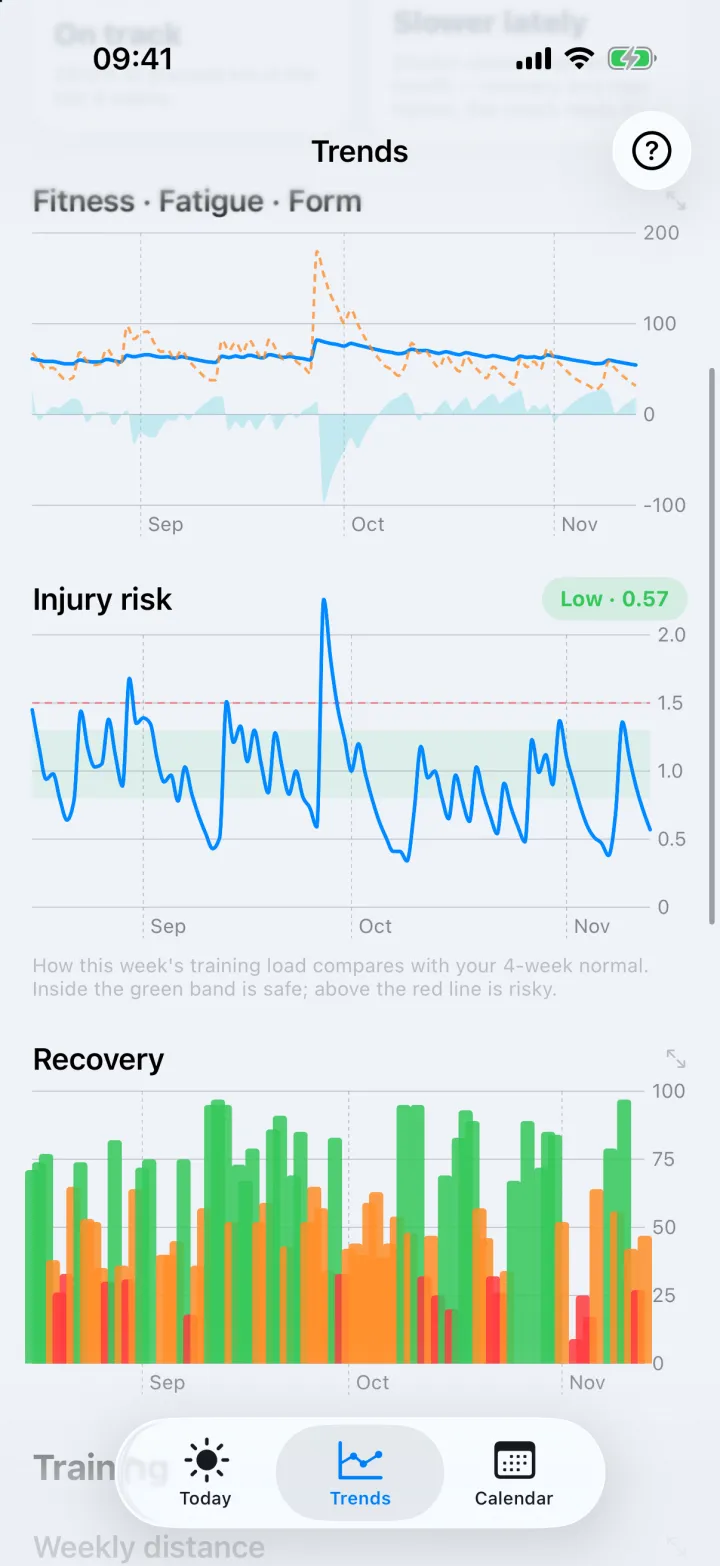
- Injury risk. A plain low, medium or high reading from how fast your load is rising.
- Fitness, fatigue and form. The long view of your training load.
- Recovery, HRV and resting heart rate. From your strap, on the same timeline as your training.
- Weekly distance and weekly climb.
- Stride. Stride length per run, over time.
Before and after the run
- Warm-up and cool-down for each session. A short video routine matched to the kind of run.
- Tick them off. Completed routines are recorded alongside the session.
Your data
- No double counting. A run recorded by your watch and your strap is one run.
- When two sensors disagree, the app says so. If heart-rate readings conflict, you see both and which one was trusted.
- Import activities from a file. GPX and TCX.
- Export your plan. As a calendar file for Apple or Google Calendar.
- Sign in with Apple or Google.
In the app
A closer look
Join the private beta
Closed Loop is invitation-only while we test it with a small group of runners. Email us and tell us what you are training for.
enroll@halo-design.netiPhone with iOS 17 or later. Installed through Apple TestFlight. Free during the beta.